

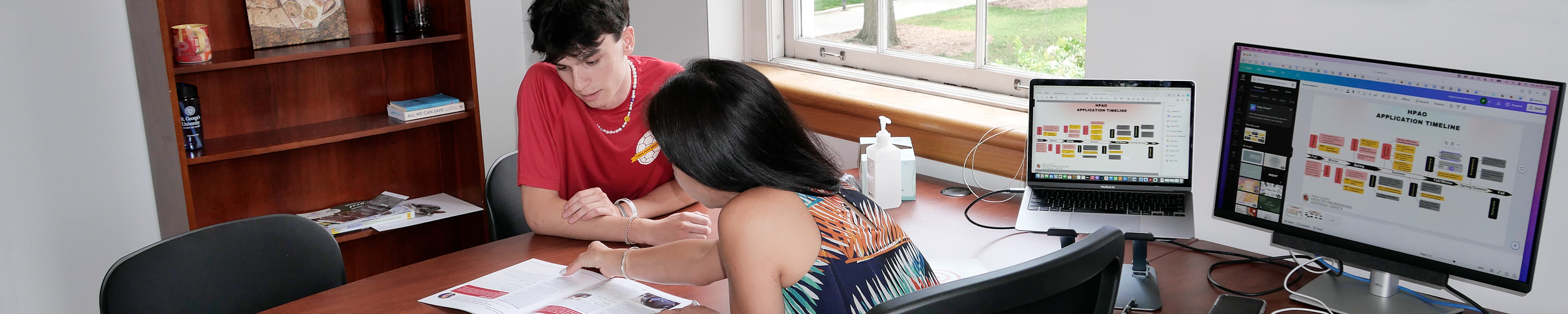
The process of applying to health professions school is complex. We are here to help!
The primary way that we communicate and share information with students during their application year is through our dedicated Committee Process Canvas course. If you are planning or considering whether to apply in the upcoming cycle, please join the Canvas course.
The Committee Process Canvas course will:
- Help student confirm their eligibility and readiness to apply
- Highlight deadlines and best practice timelines
- Communicate requirements for the Committee Process
- Share tips and resources for completing applications
- Ensure consistent and timely information from the advising team
Students applying to medical or dental school in a given year are encouraged to utilize our Committee Process, which includes:
- The Pre-Health Packet: a comprehensive questionnaire that helps students think reflectively about their pre-health motivation and relevant experiences.
- Packet Review Meeting: students will have a one-on-one meeting with an advisor to review and receive feedback on their packet.
- Personal Statement review
- Mock Interview: students interview with a member of our committee and receive feedback; this is important preparation for professional school interviews
- Primary Application and School List Review: students will meet one-on-one with an advisor to discuss aspects of their primary application and a potential list of schools.
- HPAO Letter Packet: HPAO will compile and send individual letters of recommendation (after checking to ensure that each letter complies with standards regarding date, letterhead, and signature), along with a cover memo describing the UMD HPAO Committee Process and the student's participation in each phase.
*Please note that students who have previously been accepted to health professions school are not eligible to use the Committee Process.
In addition to regular advising, HPAO will hold in-person and virtual workshops that address such topics as:
- Are You Ready?
- Articulating Your “Why” for Professional School
- How to Write your Personal Statement
- Letters of Recommendation
- Building Your School List
- How to Navigate the Application Process
- Situational Judgement Tests
- Multiple Mini Interviews (MMIs)
There is no universal "right" time to apply to professional school; the best time to apply is when you have fully interrogated your motivation for a career in health care and are positioned to submit a well-rounded and competitive application. Students who wish to matriculate to medical or dental school immediately after graduation should have all aspects of their application completed by the June following their junior year. Students who take one gap year will apply the June following their senior year.
Please work with HPAO to help understand your competitiveness and determine the best timeline for you. Nationally, more students than not take at least one gap year. Our advisors will encourage you to consider:
- Are your metrics competitive? Do you need additional coursework or standardized prep time to bolster your metrics?
- Have you interrogated your motivation for a career in healthcare and shown your commitment to this career path through substantive clinical experiences?
- Have you invested in your community and shown an interest in the lived experiences of others through longitudinal service?
- How have you engaged with scientific inquiry and knowledge production through research?
- Have you created and maintained relationships with professors or former clinical/volunteer supervisors for Letters of Recommendation?
- Have you confirmed that you meet or exceed the competencies expected by professional schools?
- Will you have time to complete all aspects of your application (including studying and sitting for your standardized exam while fulfilling your academic and extracurricular obligations?
- Are you aware of the costs associated with applying?
Students don't always initially plan for a gap year; however, the extra time can be very beneficial. A gap year allows for such things as additional test preparation, longitudinal service, clinical and research experiences, personal enrichment and rest. Many of our students are grateful in retrospect that they took an extra year before diving into another academically intense experience!
Applying to health professions school is an involved and lengthy process. For medical and dental school applicants, it takes approximately 14 months between submission of the primary application and matriculation (for example, students who submit their application in June 2027 will begin medical/dental school in late summer/early fall of 2028). Through the Committee Process, you will engage consistently with HPAO in the six months leading up to your application and during your application year. Below is a general application timeline; more detailed information about the timeline and application process can be found on our Committee Process Canvas Course.
2026 |
|
Aug-Sept |
Make sure you are set to receive notifications from 2028 Cycle course. Add relevant workshops to your calendar. |
October |
Attend the Are You Ready? Workshop to confirm your readiness to apply in the 2028 cycle. |
October |
MCAT registration opens for Jan-September test dates. Plan to spend 4-6 months studying for the MCAT/2-4 for the DAT. Your first attempt should be no later than June 30, 2027. |
November |
If you plan to apply in the upcoming cycle, purchase the First-Time Applicant Pre-Health Packet (available November 1 and due by February 15, 2027 at 4:30 p.m) Open an Interfolio account and begin collecting letters of recommendation. |
2027 |
|
February-May |
Attend relevant workshops offered by HPAO. |
February 1 |
The Re-Applicant Packet is available and due May 10, 2026 at 4:30pm–no exceptions. |
February 15 |
First-Time Applicant Pre-Health Packet due at 4:30pm–no exceptions. |
January-July |
Schedule and attend one-on-one meetings with the HPAO Committee:
|
May 10 |
Re-applicant Packet due at 4:30pm–no exceptions. |
May- August |
Common Application Services open: AMCAS will open early May and go live for submissions at the end of May. AADSAS will open mid May and go live for submissions in early June. AACOMAS will open and go live for submissions in early May. OPTOMCAS will open and go live for submissions in July. TMDSAS will open and go live for submissions in May. AACPMAS will open and go live for submissions in August. |
May |
Submit transcripts from all attended colleges/universities to your Common Application Service(s) only after your spring grades have been posted (usually ~May 25). HPAO does not forward transcripts. |
June-August |
HPAO moves to limited drop-in hours just for current cycle applicants. Be aware of this and PLAN ACCORDINGLY. |
June-July |
For best consideration, HPAO recommends submitting primary application(s) for medical/dental schools by June 7. HPAO recommends taking any required Situational Judgement Tests (Casper, PREview) by June 30th. |
June 1 |
Letters of recommendation due in Interfolio. |
July-September |
Complete and submit secondary applications to schools within two weeks of receiving them. |
July 15 |
Deadline to complete remaining required meetings for the Committee Process:
|
December |
Send fall transcript and/or relevant updates to schools still considering your application (refer first to school-specific information concerning updates, as some schools do not accept them). See a health professions advisor if you have not heard from schools. |
2028 |
|
February |
Update HPAO on your application status and any acceptances. |
February-April |
If waitlisted, follow up with schools. Purchase Re-Applicant Packet, if applicable. Follow Traffic Guidelines for all schools. |
August |
Matriculate to Professional School! |
Detailed guidance on the costs of applying to professional school is available on our Canvas Courses.
Assistance with Standardized Testing and Application Fees: Support exists for students who need financial assistance paying for their standardized tests and applications to professional school. Please consult each of the common application services for information about fee assistance and application costs:
Dental School: ADEA Fee Assistance Program and Application Costs
Medical School (Allopathic): AAMC Fee Assistance Program and Application Costs
Medical School (Osteopathic): AACOM Application Fee Waiver and Application Costs
Nursing School: Nursing Application Fee Assistance and Application Costs
Occupational Therapy: OTCAS Fee Assistance and Application Costs
Optometry School: Application Costs (no fee assistance available)
Pharmacy School: PharmCAS Fee Assistance and Application Costs
Physical Therapy School: PTCAS Fee Assistance and Application Costs
Physician Assistant School: CASPA Fee Assistance and Application Costs
Podiatry School: AACPMAS Fee Assistance and Application Costs
You will not get into professional school on your own! The vast majority of programs require letters of recommendation, so it is important to make the effort to get to know your professors and clinical/research mentors. Recommendation letters are an important part of your application, as they provide insight into your strengths and help schools in their mission-aligned selection and retention of candidates. Most professional schools request that you submit three to five letters of recommendation (e.g., medical schools often require a minimum of two science letters, one non-science academic letter, and one clinical letter). You are responsible for researching individual school letter requirements; use individual school websites, along with the MSAR, Choose DO Explorer or Dental School Explorer, to confirm.
Letters of recommendation can be collected at any time during or after your undergraduate career. We recommend that you create an account in Interfolio to request and gather letters, which can be stored until you are ready to apply (this is a free service).
For more detailed information, please see our Letters of Recommendation FAQ
Any coursework that you complete after earning your undergraduate degree is considered "post-bac" coursework. There are many different reasons students either choose to, or are required to, engage with additional coursework after graduating with a bachelors degree. Some reasons include:
- To complete pre-requisite courses before applying to professional school
- To demonstrate academic preparedness by raising their GPAs through post-bac courses
- Discovering their goals later in their undergraduate career and needing to take additional sciences
Use the chart below to identify if you need post-bac work, and if so, which type of program best fits your needs.
The following links below are good places to begin your search for the best post-bac program for you.
American Association of Medical Colleges (AAMC) Post-Bac List
American Association of Colleges of Osteopathic Medicine (AACOM) Post-Bac List
American Dental Education Association Post-Bac Information
Johns Hopkins Article on Different Post-Bac Options
UMD Science in the Evening Program (consider this option for completing or re-taking pre-requisite courses)
International students face several obstacles to pursuing health professions degrees in the United States, including restrictions on eligibility, a limited number of available slots, and scarcity of funding. Many programs do not accept any international applicants (i.e., applicants must be a U.S. citizen or permanent resident); other schools may accept only a few. There are often residency or citizenship requirements for scholarships and financial aid.
International students interested in medicine should consult the individual school's websites or entries in the Medical School Admission Requirements (for allopathic schools) and the Choose DO Explorer (for osteopathic schools) to determine whether applications are accepted from international applicants. More information for international applicants is available on the AAMC website.
ADEA offers guidance for international students wishing to pursue dentistry.
DACA recipients and undocumented students can also utilize resources available through the organization PhDreamers for additional assistance.